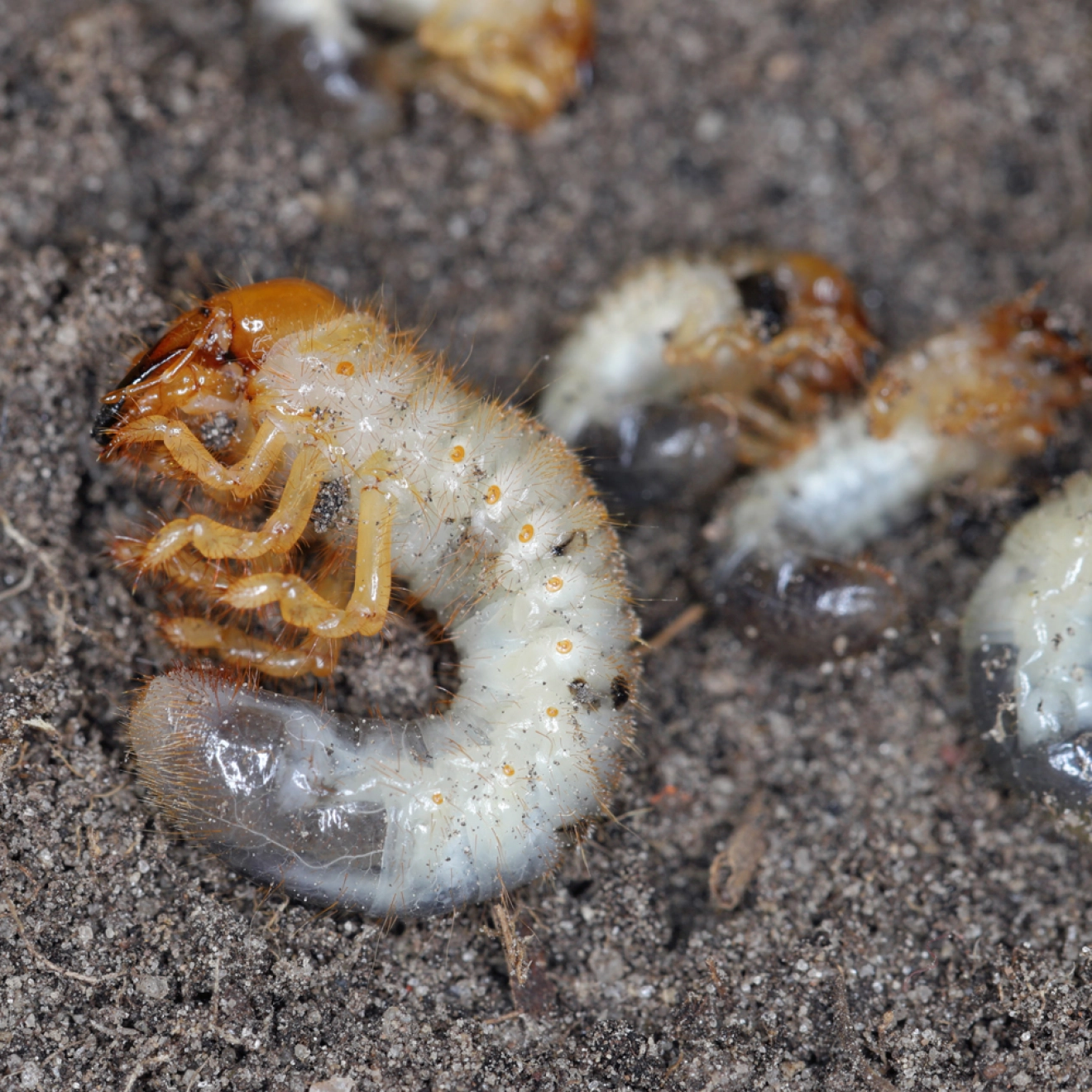
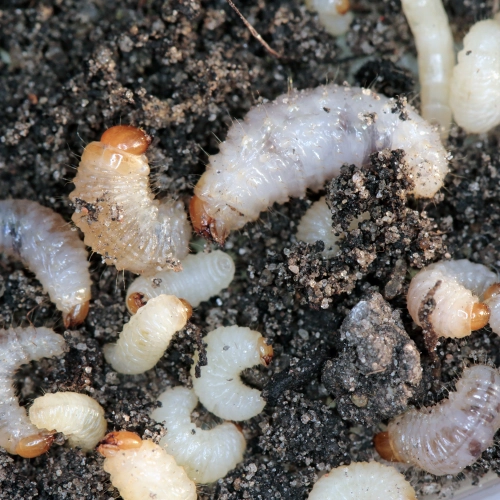
Chafer grubs are the larvae of the chafer beetle - of which there are several different types. They feed on grass roots weakening the grass which can then be pulled up easily.
Chafer Grubs are very easily recognised; they are quite large at one-two inches long, with white/cream bodies and a brown head. They have six brown legs, and they are usually curled into a C shape in the soil under turf.
The female chafer beetle will burrow down into the ground and lays eggs near plants in summer; the larvae hatch out a few weeks later. They will then pupate over winter and hatch as adults in late spring.
Identifying Chafer Grub Damage
Chafer grubs can cause significant damage to lawns and turf. The most common signs of a minor chafer grub presence are brown patches of grass.
If you look closely, this brown grass can be pulled up easily because the grubs have eaten the roots. This should not be confused with droughted grass that has gone brown – this will not pull up easily as the roots will still be formed in the ground.
Secondary damage comes in the form of birds and mammals eating the grubs and pecking holes in the turf/ripping it up completely as they do so. This is often the first time people will notice the presence of chafer grubs.
What is Biological Chafer Grub Control
Biological controls are non-chemical treatments that rely on the natural enemies of pests. In the case of chafer grub control, the enemy is the nematode, specifically, the species Heterorhabditis bacteriophora.
Nematodes are microscopic worms that actively seek out the chafer grubs, feeding and multiplying inside them, then infecting them with a bacterium.
Once infected, the chafer grub will stop feeding and die. The nematode will then leave the dead chafer grub and go on to seek out more, repeating the cycle.
Biological chafer grub control is a highly effective, safe treatment that can be used on turf as well as ornamentals. It is safe for pets and other wildlife and the perfect choice for organic gardeners.
How Many Nematodes Do I Need?
We sell biological chafer grub control in packs that cover the following areas:
There are millions of microscopic nematodes in each pack – carefully worked out to ensure accurate application for each specific area listed. Each application of nematodes will provide at least six weeks control of chafer grubs.
Nematodes are supplied as an easy-to-mix powder which needs to be diluted with water before use. Specific dilution rates are shown in the table below.
How to Apply Biological Chafer Grub Control
Apply to moist compost/soil using a watering can or sprayer.
|
Pack size
|
Dilution rate
|
Application instructions
|
|
10m2
|
1 pack of nematodes in 10L water
|
Dissolve the pack in 1L litre of water to create a stock solution. Take 500ml of the stock solution and add to a watering can of 4.5L water. Apply this over 5m2 and repeat process until you have used all of the stock solution and covered 10m2
|
|
50m2
|
1 pack of nematodes in 25L of water
|
Dissolve the pack in a bucket containing 2.5L of water to create a stock solution. Take 500ml of the stock solution and add to a watering can of 4.5L water. Apply this over 5m2 and repeat process until you have used all of the stock solution and covered 25m2
|
|
100m2
|
1 pack of nematodes in 50L of water
|
Dissolve the pack in a bucket containing 5L of water to create a stock solution. Take 500ml of the stock solution and add to a watering can of 4.5L water. Apply this over 5m2 and repeat process until you have used all of the stock solution and covered 50m2
|
|
500m2
|
1 pack of nematodes in 50L water
|
Remove fine filters from application equipment. Dissolve the pack in a bucket containing 10L of water to create a stock solution. Take 2.5L of the stock solution and add to a knapsack with 10L of water. Apply this over 125m2 and repeat process until you have used all of the stock solution and covered 500m2. Irrigate immediately to disperse nematodes into soil.
|