Unfortunately, driveway moss has a habit of coming back. Removing the visible growth is only part of the solution. Understanding why moss develops, and choosing the right treatment for your driveway surface can make ongoing maintenance much easier.
Why Does Moss Keep Coming Back on Driveways?
Moss thrives in damp, shaded and poorly drained environments. Driveways can provide exactly these conditions, particularly during the wetter months of the year.
Block-paved driveways are incredibly popular, but moss can very easily get a hold in the spaces between the blocks, especially where they are not maintained or properly installed. This can quickly turn a pristine, once aesthetically pleasing drive, into a mossy mess.
Areas beneath trees, alongside walls, or where vehicles and surrounding vegetation restrict sunlight can remain damp for longer. Leaves, dirt and other organic debris can also accumulate, providing an ideal environment for moss to establish.
Porous and textured surfaces can be particularly susceptible. Even after moss has been removed, spores can remain in the surrounding environment and quickly recolonise when conditions become favourable.
This is why regular driveway maintenance and preventative treatment are important if moss is a recurring problem.
Which Driveway Surfaces Can Moss Grow On?
Moss can establish on a wide range of driveway materials, including:
Concrete – its porous surface can retain moisture and provide a suitable environment for moss.
Block paving – as described above, moss can develop across the blocks but particularly around joints where moisture and debris collect.
Tarmac and asphalt – moss can establish where the surface remains damp or has accumulated dirt and organic material.
Gravel – moisture and organic debris between stones can encourage moss and algae.
Natural stone – textured and porous stone can provide plenty of places for moss to establish.
Resin-bound surfaces – although generally less prone to moss than some other porous surfaces, damp conditions and accumulated debris can still encourage organic growth.
Because driveway materials differ, always check that a moss treatment is suitable for the specific surface before application.
How to Manage Moss on a Driveway
The most effective approach is usually a combination of physical removal, appropriate treatment and regular maintenance.
Start by removing loose moss, leaves and debris with a stiff brush or suitable cleaning equipment. Avoid relying solely on pressure washing. While pressure washing can remove visible moss and grime, it can cause a lot of damage to the surface and doesn't necessarily address the conditions that allowed the moss to establish in the first place.
Once the surface is clear, this is when you need to apply a product appropriate for the type of growth and driveway surface:
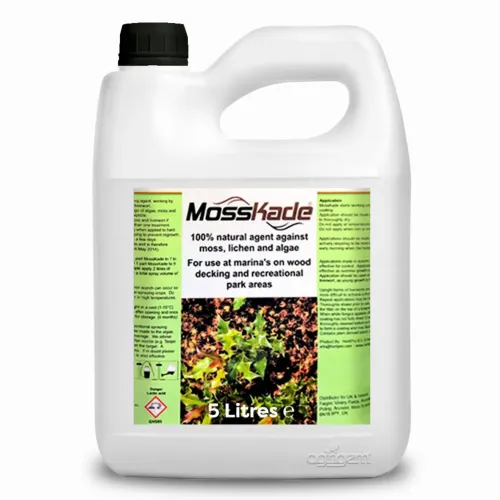
MossKade: Suitable for Concrete Driveways
MossKade Natural Moss Killer is specifically designed to control moss, algae, lichen and liverwort on hard surfaces. Importantly for driveway maintenance, MossKade can be used on concrete.
Made from natural plant-derived ingredients, it works by physically coating the target growth. We recommend applying it in autumn, winter or spring and repeating applications as necessary.
MossKade is worth considering for homeowners and grounds maintenance professionals dealing with recurring moss on concrete areas. It is made from 100% natural ingredients – plant-derived starch, proteins, oils, lactic acid, and water.
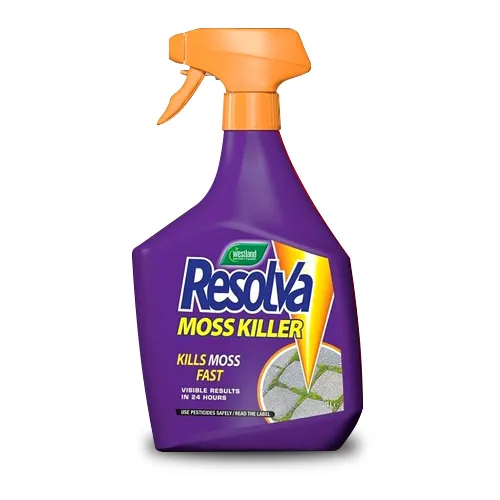
Resolva Moss Killer: For Permeable Driveway Surfaces
For permeable surfaces such as block paving and gravel, Resolva Moss Killer provides a convenient option.
It is supplied ready to use and is designed to control moss and algae on natural and permeable surfaces. Results can be visible within 12 hours under suitable conditions.
However, surface suitability is particularly important with this product: it should not be applied to impermeable surfaces such as concrete or tarmac, where runoff could enter drains or adjacent land. Always read the label before use.
New Way Weed Spray: Moss and Weed Control for Hard Surfaces
New Way Weed Spray is a natural, glyphosate-free option for controlling both moss and weeds on hard surfaces. Its active ingredient is 240g/L acetic acid, and it is suitable for use on hard and artificial surfaces - including driveways and pathways.
One of the advantages of New Way is that it can tackle more than just moss. As well as controlling hard-surface moss, it works against a wide range of weeds and grasses, potentially removing the need for separate moss and weed treatments. It is fast acting, with treated moss and weeds typically beginning to die back within 1-2 days under suitable conditions.
This makes it particularly useful for driveways where moss is growing alongside weeds, such as between paving or along driveway edges.
For best results, apply when weeds and moss are actively growing and ensure the target growth is thoroughly wetted. New Way has no residual effects in the soil, although perennial weeds may require repeat treatment. Always read and follow the product label before use
Sapphire Pro: Managing Green Algae
Not all green growth on a driveway is moss. If the problem you're seeing is green algae, Sapphire Pro Hard Surface Cleaner is designed specifically for controlling algae on outdoor structures and hard surfaces, including porous and non-porous surfaces.
Sapphire Pro is therefore worth considering where green algae are contributing to the discolouration or slippery appearance of a driveway. It is an algae treatment rather than a moss killer, so correct identification of the problem is important.
Always consult the product label to check products are appropriate and approved for your particular driveway surface.
Keeping Driveway Moss Under Control
The key is to make your driveway surface less favourable to regrowth and deal with organic growth before it becomes established.
Regularly sweep away leaves and debris, keep drainage areas clear, remove moss promptly and treat recurring growth with a product suitable for the driveway surface.
For more detailed guidance, see How to Remove Moss on Hard Surfaces.
With the right combination of cleaning, treatment and preventative maintenance, you can keep driveway moss and other unwanted growth under control and maintain a cleaner, safer-looking driveway throughout the year.
This post was written in collaboration with Ollie Wright.
Ollie Wright MBPR, FQA
Ollie Wright serves as the Technical Manager at Agrigem, where he oversees the integrity and accuracy of the company’s technical output. A recognised figure within the UK turf-growing sector, Ollie leads Agrigem’s technical response, ensuring that all guidance provided to retail and trade clients remains rigorous, compliant, and at the forefront of industry standards.
With a career built on a foundation of practical experience in farming and landscaping - including the successful management of his own firm - Ollie bridges the gap between theoretical science and field application. His extensive hands-on background is reinforced by industry credentials, including RHS Horticulture, amenity turf and hard surface BASIS, and FACTS qualifications. This unique combination of expertise allows him to deliver high-level strategic advice across diverse sectors regarding plant protection products and complex legislative requirements.
Roundup Biactive Weed Killer is a trademark of Monsanto. It contains 360g/L glyphosate.
Sapphire Pro is a trademark of Agrigem Ltd. It contains 500g/L nonanoic acid.
New Way Weed Spray is a trademark of Headland Amenity Ltd. It contains 240g/L acetic acid.
Resolva Moss Killer is a trademark of Westland Horticulture Ltd. It contains pelargonic acid.
Mosskade is a trademark of Fargro. It contains natural plant derived starch, proteins, oils and lactic acid.
Use plant protection products safely. Always read the label and product information before use. For label and safety information, refer to the manufacturer’s website.
Only certified users may apply professional plant protection products. Find out more about safe use of pesticides here.